
The Grey Uncoupling
Calling It Quits After Decades Together

The Statistics
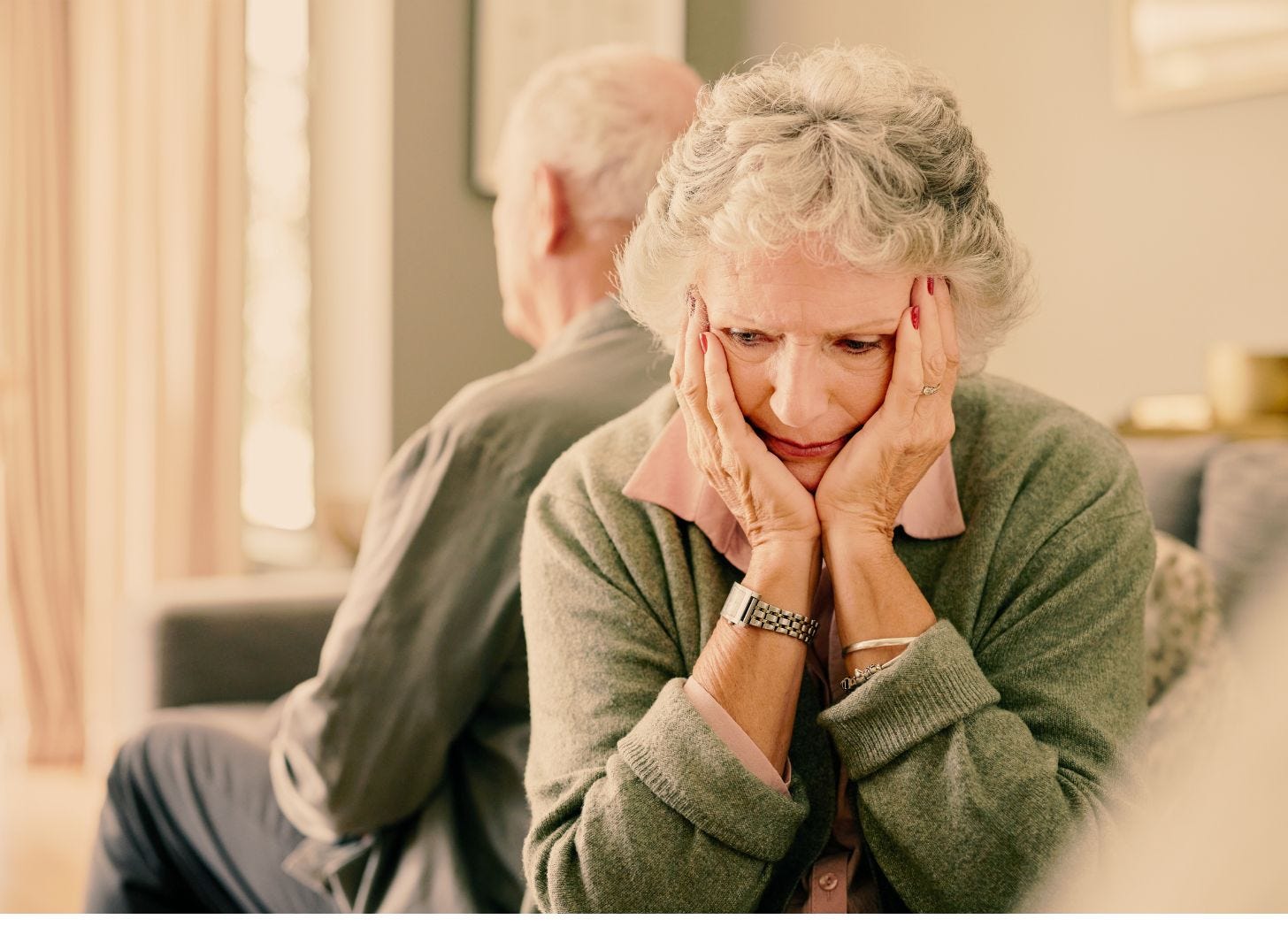
The ‘Grey Divorce’ (over 50), ‘Silver Separations’ or Silver Splitters’ (60s & 70s) - the naming of a social shift that’s ditching ‘till death us do part’.
Lisa Edser reports in The Senior that people who had been married for over 20 years ‘represented more than a quarter of all divorces in 2021’, according to data from the Australian Institute of Family Studies.
This trend in separation among baby boomers and older Gen Xers after decades of commitment is occurring despite a decline in the overall divorce rate in Australia - 56,244 divorces in 2021. In the 1980s and 1990s, only about one in five divorces involved couples aged 50 or older.
Concerning women, Nikki Parkinson states that grey divorce is ‘having a moment’ because women are waking up in midlife ‘and quietly refusing to shrink any further.’ She argues against seeing these divorces as a collapse or a failure, an unravelling. Rather, for a lot of women, it is a ‘reclamation’, born out of a form of midlife rebellion. Women are giving themselves permission to want joy and peace and ‘no longer carry what has been quietly breaking them for years.’
In the United States, the divorce rate for those over 50 has doubled, and for those over 65, it has tripled. In the 1990s, only 8% of people over the age of 50 divorced in that year. But today, 40% of people divorcing in the United States are over 50, and 10% are over 65.
Barnes & Diehl, American Attorneys At Law, say national studies confirm that women file first in the vast majority of cases, initiating approximately 69% to 75% of all divorces across the country. This trend has remained stable across decades and multiple sociological trends.
Why Is This Happening?
The following are the key reasons why we are experiencing this ‘moment’. It is most likely that the decision to divorce will be based upon a conflation of several of the examples below.
Divorce is no longer ‘taboo’. A divorcee is no longer stigmatised. A Catholic divorcee who has not remarried can now receive Communion.
Divorce at this age can be more amicable when there hasn’t been a major event, such as an affair. Nicole Kidman and Keith Urban’s divorce is hailed as a shining example.
The impact of financial pressures and/or challenges with adjusting to retirement, where two people are suddenly face-to-face more often, day-to-day.
People are living longer and are healthier, and once the children leave home, they no longer feel bound to stay ‘for the sake of the children’.
When the kids have left, old issues that were not previously dealt with rise to the surface.
Failure to prioritise the marital relationship/partnership. Two people ending up with nothing in common anymore.
Poor communication, especially when criticism, stonewalling, contempt and refusal to take responsibility are involved.
Different life plans or goals, and a lack of willingness to compromise.
Lack of intimacy and spontaneity. Women want to live the rest of their lives for themselves if they are not happy. Twenty or thirty additional years with someone you are not satisfied with is a long time, especially for women who have been lonely in their marriage, sometimes for years.
Women are more confident and are participating in the workforce, which gives them financial independence and more life choices.
Unique Challenges
Separation Distress - Your brain’s way of trying to cope with overwhelming change
Regardless of who requested the divorce, there will be a grieving process to go through for the end, often felt like a death, of the marriage. This experience is referred to as ‘separation distress’; one of the toughest life experiences people can face.
When a couple has lived together for a decade or more, there are multiple losses: the relationship, the familiarity and predictability, future dreams and plans that are no more, family traditions, all of which are extremely disorienting.
As a consequence, there are so many emotions to deal with, all of which take time to process. In addition to the grief, there may well be sadness, confusion, guilt, anxiety, panic, overwhelm, fear, and loneliness. It can feel like being on a rollercoaster, and even four or five years later, an event, a surprise encounter, a reminder can bring up unexpected emotions that you thought you had well and truly dealt with.
In my first marriage, I always cooked a turkey for Christmas dinner, using my father’s traditional English recipe. In my second marriage, my second husband cooked Christmas dinner on our first Christmas together, while I took my three younger children to Church. I felt completely disoriented. In that moment, I really ached for my family’s former Christmas tradition, where we would all return after Church, and the turkey would be in the oven, ready to be basted, making the house smell wonderful! My second husband was a superb cook, but it just wasn’t the same.
Common Physical Symptoms
Sleep and appetite changes
Tight chest and shallow breathing
Fatigue
Restlessness
Behavioural Symptoms
Withdrawal
People-pleasing
Conflict avoidance
Obsessive information-gathering
Economic Consequences
Standard of Living
In the case of grey divorce, the division of assets causes both parties to experience a drop in living standard.
However, women experience a larger drop in their standard of living than men do. In the case of grey divorce, it is often a 45% decline compared to men’s 21%. Research by the University of Melbourne found that while separation can reduce a man’s disposable household income by 5 per cent, for women it is closer to 30 per cent.
Barbara Barbosa Neves, a Monash University sociologist, said women were more likely to be pushed below the poverty line after a grey divorce. This is because older women are ‘more likely to have worked part-time while raising children and dealing with care responsibilities, or have not worked at all.’ The financial impact of divorce for older women can linger for decades.
In many Western societies, there is now a record number of post-divorce renters, because older divorcees are less likely to have the finances to buy new homes and get mortgages.
Housing Stress
Australia
Fiona York, Executive Officer, Housing for the Aged Action Group, says older women are ‘the fastest growing cohort of homeless people in the country.’ The advocacy group assists individuals aged 50 and over who are experiencing financial hardship or housing stress, many as a consequence of divorce or separation.
Fifty-four-year-old Hollie Bregg had no money and no superannuation after her marriage ended. She sacrificed a salary and superannuation to raise three children. But now, despite being on a reasonable salary and paying the equivalent of a mortgage each week for a one-bedroom flat in Sydney, she lives week-to-week and panics about her housing insecurity and retirement.
Hollie has been forced to move three times in the past three years, downsizing each time. Accepting that she will never be able to escape the rental cycle and save the deposit for a house, even with her salary, she is thinking outside the box. She would be willing to consider a Tiny Home, a shipping container, or buying a room.
Yumi Lee, CEO, Older Women’s Network, NSW (OWN), says Hollie’s story is illustrative of one of the common entry points into housing insecurities. She wants the government to become more creative in ways to help retirees into secure and affordable housing.
Given the severe housing shortage in Australia and rents that continue to rise, it’s hard to see how the situation can improve without innovative thinking (e.g. local councils making zoning changes to allow for more Tiny Homes options) and creative government vision.
United States
As Underwood Law point out, the couples who split up in their 50s and beyond are also the generation that holds the most real estate in the country. This, in turn, has an unexpected impact on the housing market, because a grey divorce doesn’t immediately put property on the market. However, it may add to an already bloated demand.
Furthermore, older buyers/renters are competing for the same entry-level houses as Millennials and Gen Zers, intensifying competition by ‘aggressively targeting condos, townhouses, and smaller single-storey homes’.
As in Australia, a significant proportion of grey divorcees do not have sufficient funds after they split to buy a home outright. Instead, they are flooding the rental market. Those with the means are driving the demand for high-end active-adult rental communities.
Another popular trend amongst divorced, widowed, or single women in their 60s and beyond, whose standard of living may have been cut by nearly half, is to share a house with unrelated peers to combat financial insecurity and social isolation. Tenants share expenses and enjoy each other’s companionship.
Resources
Substack Podcast
@womenlivingwellafter50 - Surviving a Midlife Marriage Breakdown
@cindyditiberio - The Mother Lode - The Ultimate Divorce Resource Guide
This is an extensive curated resource guide, but to access it, you will have to subscribe to the newsletter.
YouTube
Splitting Silver Hairs: A Guide to Grey Divorce in Australia
Magazine
The Divorce Magazine - UK
Have you been through the experience of Grey Divorce or a Silver Separation? If so, what helped you the most to survive and thrive after the experience?

References
Barnes, & Diehl (2025, September 29). Are Men or Women More Likely to Initiate Divorce? Retrieved January 12, 2026, from https://www.barnesfamilylaw.com
Edser, L. (2025, July 28). The Growing Housing Crisis No One Talks About, And The Women Left Behind. The Senior. https://www.thesenior.com.au/
Edser, L. (2025, December 11). The rise of grey divorce: How older Aussies are calling it quits. The Senior. https://www.thesenior.com.au/
Mahe, D., Rafferty, M., & Dyer, N. (2024, March 24). Grey divorce is on the rise with more Australian couples splitting after the age of 50 than ever before. Abs.net.au/News. Retrieved January 10, 2026, from https://www.abc.net.au/
Underwood Law (2025, December 29). Gray divorce: How the splitting of older households is impacting the housing market. Halston Media Group. Retrieved January 13, 2026, from https://news.halstonmedia.com
“quietly refusing to shrink any further.”
that’s not a midlife crisis, that’s a spine growing back. clear-eyed, grounded, and brave in a very unglamorous way... choosing yourself even when it’s expensive, messy, and late in the story.
The assumption is that only women need these changes. My partner’s daughters suggested divorce from their unkind mother whose verbal abuse and self-involvement chacterized the marriage. Family and friends celebrate its end.